
Better than we found it
For more than 30 years, we’ve lived on six acres in Chester County, Pennsylvania, slowly transforming an 1800s farmhouse, two barns, and a backyard retreat we call Sans Souci—French for “without worry.” It’s our sanctuary, a place where problems stop at the gate. At least, that’s the plan.
The fields around us have never sat idle. Over the years we’ve laid out, mowed, and maintained a full-size lacrosse field for practices, a baseball diamond with a mound and backstop, a competitive disc golf course, and staged cyclocross races and high school mountain bike practices. The barns have been the site of raging parties and late-night jam sessions, and even incubated Virtual Farm Creative in its earliest years as one of the region’s most creative and enduring branding agencies.
Each project was a serious effort, and each left its mark. But season after season, the ground itself produced little more than cheap hay.
Leave it better than you found it” has always been my personal motto—whether in work, projects, or relationships—and now we can finally apply it to the land we’ve loved for more than three decades.
Every spring we plant a sizable vegetable garden, but every summer we wonder if the unused four acres could do more. We’ve considered cash crops—flowers, tree stock, pumpkins—but this year the question shifted. Why chase revenue when the land could be regenerative? Why not focus on restoring the soil, feeding people, and leaving something better than we found it?
That’s where permaculture comes in. It’s not new—nature has always done it this way—but it is transformative. Instead of single crops in rows, the goal is a food forest: trees, shrubs, and perennials arranged in “guilds” that support one another. Guided by three principles—Earth Care, People Care, and Fair Share—it’s about abundance that circulates, not extraction.
In September 2025 we’re still in the design stage, working with a certified permaculture designer: a small-scale farmer and creative mind who helps people close loops, repurpose resources, and build systems that endure.
This isn’t about crates of produce leaving our fields. If something thrives here—some unexpected heirloom variety—it will be small-scale and artisanal, tied to local tables and local stories. The goal isn’t mass yield, it’s lasting value.
Originally a horseradish farm where the Yeager family ground-up and bottled the roots in the small barn which they carted to far off places like Reading Terminal Market–first by horse and then in one of the first internal combustion powered trucks–this will be the second chapter of Sans Souci as a farm that we know of. Today people lament the loss of farmland in the suburbs but remember, that land was something wilder before it was farmland. La Ferme Sans Souci is adopting Where the Wild Things Are as our tagline and we’ll see what pops up as things evolve.
Today it’s soil tests, sketches, and conversations. Soon it will be planting, tending, and adapting. We’ll share the process as it unfolds—not just what grows, but what we learn. Because this isn’t about using land up. It’s about regenerating it for whoever comes next.
We’ve raised two children here, and now that they’re off chasing their own dreams, we have the time. With this new chapter, we’re ready to reimagine the fields not as empty acres, but as a living system. These are the reasons we decided to plan and plant a food forest now:
– To transform the land into something genuinely useful
– To create a vocation that aligns with our interests and ethos
– To (potentially) develop a retirement gig that gives more than it takes
This is the work ahead of us—slow, deliberate, and regenerative. If we succeed, Sans Souci will grow into more than a home; it will become a legacy rooted in care for the earth, for people, and for the future.
Stay curious.
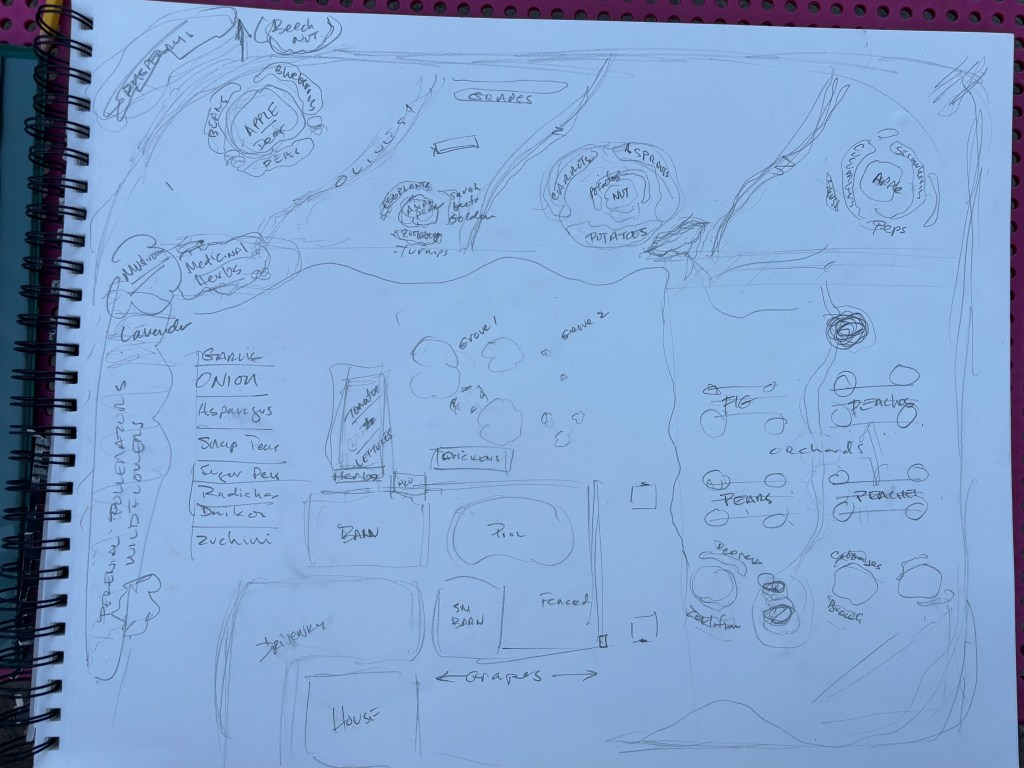
The sketchbook start

 PALM READER